
Election Monitoring & INEC Observer Jobs in Nigeria 2026/2027
Elections in Nigeria are always a massive deal. With the 2027 general elections drawing closer and several off-cycle gubernatorial elections happening in 2026 (like in Osun, Ekiti, or Anambra depending on the calender), the political atmosphere is already getting charged up. But beyond the politicians and their noisy campaigns, there is a huge logistical mountain that needs to be climbed. How exactly do you conduct a credible election in a country with over 200 million people spread across 36 states and the Federal Capital Territory? The answer is quite simple: you need serious manpower.
Every single election cycle, the Independent National Electoral Commission (INEC) recruits hundreds of thousands of ad-hoc staff to help out. Honestly, without these temporary workers, Nigerian elections would be practically impossible. And its not just about INEC staff; local and international election observer groups also need hands on the ground. If you are a youth, a student, or a graduate looking to make some extra cash, gain unique field experience, or just contribute your quota to Nigeria’s democratic journey, then securing one of these roles should definitely be on your radar.
In this comprehensive guide, I am going to break down everything you need to know about getting an INEC ad-hoc job or becoming an election observer in the upcoming 2026/2027 electoral cycle. From the basic requirements and the online application process to the actual roles and what you should really expect on election day. Grab a seat and maybe a drink, cause this is gonna be a very detailed ride.




Understanding the Difference: INEC Ad-hoc Staff vs Election Observers
Alot of people confuse these two roles, but they are actually very different. Before you apply for anything, you need to know where you fit in.
INEC Ad-hoc Staff are temporary workers hired directly by the Independent National Electoral Commission. These are the people who actually run the elections at the polling units and collation centres. They issue ballot papers, accredit voters using the BVAS (Bimodal Voter Accreditation System), count the votes, and transmit the results. Because they work for INEC, they are official umpires. They are paid directly by the goverment.
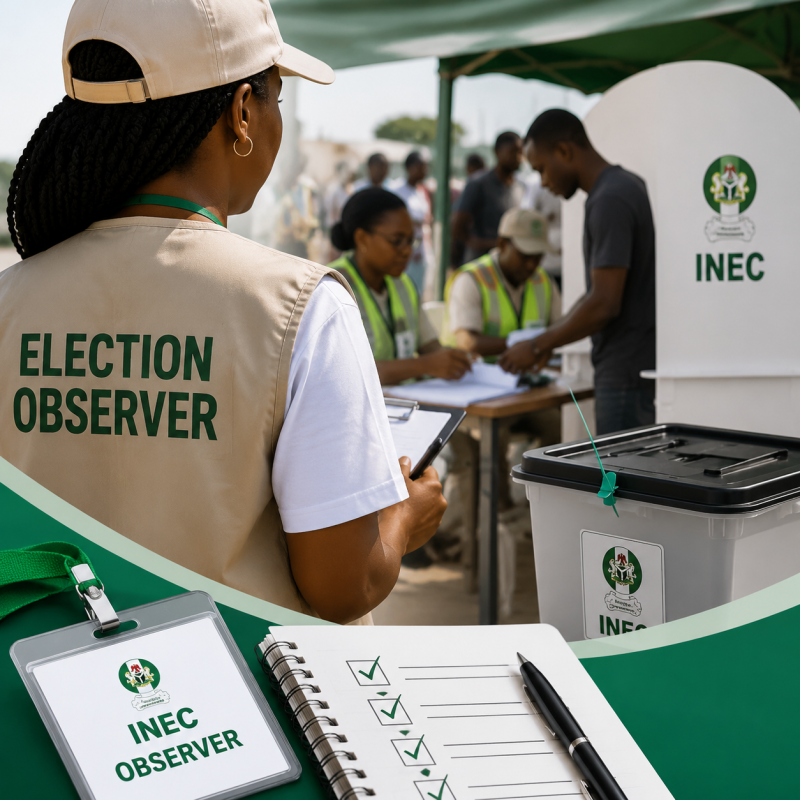
Election Observers (or monitors, though legally “monitors” often refer to INEC’s internal quality control, while “observers” are independent), on the other hand, do not run the election. They are usually deployed by Civil Society Organizations (CSOs), Non-Governmental Organizations (NGOs), or international bodies like the EU or AU. Their job is to simply watch. They observe the process to see if INEC and the voters are following the law. They take notes, record any violence or vote-buying, and write reports after the election. Observers are not allowed to touch ballot papers or interfere with the voting process. They are paid by the NGOs they represent, not by INEC.
Why INEC Needs Temporary Staff for the 2026 and 2027 Elections
You might be wondering why INEC doesn’t just use its permanent staff. Well, let’s do the math. Nigeria currently has over 176,000 polling units. INEC’s permanent staff nationwide are not even up to 20,000. There is no physical way they can cover every polling unit, ward, and local government area on election day.
This massive gap in personnel is why the commission relies heavily on ad-hoc staff. For a general election, INEC needs close to a million temporary workers. They need people to manage the queues, operate the tech devices, and ensure that results are collated accurately. For the 2026 off-cycle elections and the main event in 2027, the demand for these workers will be as high as ever. The good thing is that this creates a massive employment opportunity for young Nigerians, even if it is just for a few days.
Categories of INEC Ad-Hoc Staff Roles Available
When the INEC portal opens for the 2026/2027 elections, you will need to choose a specific role to apply for. Not all roles pay the same, and not all roles require the same level of education or experience. Here is a breakdown of the main positions:
1. Supervisory Presiding Officer (SPO)
The SPO is like the boss of a particular Registration Area or Ward. They don’t stay at one polling unit. Instead, they supervise several polling units (usually between 10 to 15). Their main job is to distribute election materials to the Presiding Officers early in the morning and ensure that voting goes smoothly across all their assigned units. To be an SPO, you usually need to be a federal civil servant (Grade Level 10-14) or a senior staff in a federal tertiary institution.
2. Presiding Officer (PO)
This is the most popular role. The PO is the head of a single polling unit. They are responsible for everything that happens there. They collect the materials from the SPO, set up the polling booth, operate the BVAS for accreditation, oversee the voting, count the ballot papers, and upload the results to the INEC Result Viewing Portal (IReV). This role is highly sensitive and is mostly reserved for serving NYSC (National Youth Service Corps) members. Sometimes, ex-corpers or federal workers are also considered.
3. Assistant Presiding Officer (APO I, II, III)
Because the PO cannot do all the work alone, they are assisted by the APOs. There are usually three APOs in a standard polling unit.
- APO I: Usually in charge of checking the voter register and confirming that the voter’s details match what is on the system.
- APO II: In charge of applying indelible ink on the voter’s finger and issuing the actual ballot paper.
- APO III: Basically handles crowd control and ensures that voters queue up properly and orderly.
These roles are usually filled by students of federal tertiary institutions (universities, polytechnics, colleges of education) and sometimes secondary school leavers with good grades.
4. Collation Officers (CO) and Returning Officers (RO)
These are the big guns. After voting is done at the polling units, the results are taken to the Ward Collation Centre, then to the Local Government Collation Centre, and finally to the State or National Collation Centre. The Collation Officers tally these results. Returning Officers are the ones who finally announce the winner of the election. Because of the heavy responsibility, COs and ROs are almost exclusively Professors, Vice-Chancellors, or senior academic staff of universities.
The Role of Election Observers and Monitors in Nigeria
If you don’t want the stress of managing voters or carrying sensitive election materials, being an election observer is a great alternative. Observers are the eyes and ears of the international community and local citizens.
During the 2023 elections, we saw how crucial observers were. Groups like YIAGA Africa, CLEEN Foundation, and the Transition Monitoring Group (TMG) provided parallel vote tabulations and real-time reports on the conduct of the elections. For 2026 and 2027, these groups will be recruiting thousands of field observers.
As an observer, your job is to arrive at the polling unit early, check if INEC staff arrived on time, verify if the BVAS is working, observe the voting behavior (checking for things like voter intimidation or vote buying), and watch the counting of votes. You will usually be given a checklist and a mobile app to report your findings back to a central situation room.
Eligibility and General Requirements for INEC Ad-hoc Jobs
Before you get excited and start looking for the application portal, you need to make sure you actually qualify. INEC is quite strict about who they hire because of the sensitive nature of elections. Here are the general requirements for the 2026/2027 recruitment:
- Nationality: You must be a citizen of Nigeria.
- Age: You must be between 18 and 35 years old (though older civil servants can apply for senior roles like SPO or Collation Officer).
- Identification: A valid National Identification Number (NIN) is compulsory. If you don’t have your NIN sorted out, you better go to NIMC now.
- Bank Account: You need a functioning bank account. The name on your bank account MUST match the name on your application. No third-party accounts allowed.
- Educational Qualification: Depending on the role, you need an OND, HND, BSc, or at least be a current student in a recognized tertiary institution.
- NYSC Status: For the Presiding Officer role, being a current NYSC member is almost a mandatory requirement. You will need your Call-up number or State Code.
- Passport Photograph: A clear, recent passport photograph with a plain background.
Step-by-Step Guide: How to Apply for INEC Ad-Hoc Jobs 2026/2027
The application process is usually 100% online. In the past, people used to go and queue at INEC offices, but now everything is digitized. When the portal officially opens for the upcoming elections, here is how you will apply:
Step 1: Visit the Official Portal
The one and only official link for INEC ad-hoc staff registration is the PRES portal. To get started or sign up when it opens, visit: https://pres.inecnigeria.org/. Please avoid fake websites asking you to pay money for application forms. INEC recruitment is completely FREE.
Step 2: Create an Account
Click on “Register” or “Sign Up”. You will be asked to provide your valid email address and a password. Make sure you use an email you actually have access to because they will send a verification link.
Step 3: Fill out the Form
Once you log in, you will need to fill out your personal details, educational background, and bank details. Take your time here. A simple mistake in your account number will mean you won’t get paid after doing the hard work.
Step 4: Upload Documents
You will need to upload your passport photograph and maybe a scanned copy of your ID card (like your NYSC ID or school ID).
Step 5: Select Your Preferred Role and State
Choose the role you are qualified for (e.g., APO or PO). You will also select the state and local government where you want to work. It is usually advisable to choose a location you are very familiar with.
Step 6: Submit and Print
After cross-checking your information, hit the submit button. You will be generated an acknowledgement slip. Print this slip out and keep it safe; you will need it during the physical screening and training.
How to Join Election Observer Groups in Nigeria
If you prefer to go the observer route, you won’t apply on the INEC portal. Instead, you need to apply directly to the NGOs and CSOs that INEC has accredited.
Organizations like YIAGA Africa, CDD (Centre for Democracy and Development), and Kimpact Development Initiative usually put out calls for volunteers a few months before the elections. You just need to follow their social media pages or visit their websites.
They typically look for young people who are tech-savvy (because you will use smartphones to send data), neutral (you cannot be a card-carrying member of any political party like APC, PDP, or LP), and resident in the local government they want to observe. The application is usually via a simple Google Form.
How Much Do INEC Ad-hoc Staff and Observers Get Paid?
Let’s talk about the money, cause let’s be real, patriotism is good but transport fare is expensive right now in Nigeria. The exact amount changes depending on the budget approved for the election, but we can make very accurate estimations based on recent off-cycle elections and the past general elections.
For INEC Ad-Hoc Staff:
- Presiding Officers (POs): Usually earn between ₦17,000 to ₦25,000 for the election weekend. This includes their training allowance, feeding allowance, and the actual election duty pay.
- Assistant Presiding Officers (APOs): Usually earn slightly less than the POs, around ₦14,000 to ₦20,000.
- Supervisory Presiding Officers (SPOs): Because they cover more ground, they earn between ₦30,000 to ₦45,000.
- Collation Officers: These senior officials can earn upwards of ₦50,000 to ₦100,000 depending on the level of collation (Ward, LGA, or State).
For Election Observers:
NGOs usually pay a flat stipend to cover logistics, data, and feeding. This stipend ranges from ₦10,000 to ₦20,000 per election day. Some well-funded international groups might pay a bit more or provide accomodation, but generally, observer roles are seen more as volunteer work than a major money-making gig.
The Impact of Technology: BVAS and IReV in Upcoming Elections
If you are planning to work in the 2026 or 2027 elections, you must be comfortable with technology. The days of using manual incident forms and just writing numbers on paper are fading away. The Bimodal Voter Accreditation System (BVAS) and the INEC Result Viewing Portal (IReV) are now the backbone of Nigerian elections.
The BVAS is a tablet-like device used to read the Permanent Voter Card (PVC) and authenticate the voter using either their fingerprint or facial recognition. If the BVAS cannot recognize a voter, that person cannot vote. It is as simple as that. As a Presiding Officer or APO, you will undergo intense training on how to operate this device, troubleshoot minor glitches, and manage the battery life.
After voting and counting, the PO will use the same BVAS device to take a clear picture of the Form EC8A (the result sheet) and upload it directly to the IReV portal using the internet. This ensures that the public can see the results from the polling unit before they are taken to the collation centre, reducing the chances of figures being changed on the way.
However, as an ad-hoc staff, you must be careful. In the past, some staff faced public anger when they couldn’t upload results immediately due to poor network or technical glitches. You need to be patient, explain the situation to party agents, and ensure you follow the strict guidelines provided during your training.
Challenges You Might Face on Election Day
I won’t lie to you and say election duty is a walk in the park. It can be very stressful. Here are some real challenges you should prepare your mind for:
1. Logistics Headaches: Moving from the Registration Area Centre (RAC) to your specific polling unit early in the morning can be chaotic. Sometimes, vehicles arrive late, and you have to hustle to get your materials to the location before 8:30 AM.
2. Harsh Weather and Lack of Facilities: Many polling units are located in open spaces under trees or in rundown primary schools. You might have to deal with hot sun, sudden rain, and a lack of decent public toilets. Always carry an umbrella, a power bank, and your own water.
3. Aggressive Politicians and Thugs: This is the sad reality of our envronment. You might encounter political thugs or desperate party agents trying to intimidate you. Your safety comes first. Never argue blindly with armed individuals. Report to the security agents (Police, NSCDC) attached to your unit immediately.
4. Technical Issues: The BVAS might freeze, or the network might completely vanish when you are trying to upload results. These things cause tension among voters who might think you are trying to rig the election. Communication is key here; always keep the voters informed about what is happening.
Crucial Tips for Staying Safe and Effective During Election Duty
If you want to have a smooth experience and get your money without any drama, here are some practical tips you should follow:
- Pay Attention During Training: A lot of young people just go to the INEC training to sign attendance and gist. Don’t do that. The training is where you learn how to handle the BVAS and fill the result sheets correctly. A cancelled result sheet can land you in serious trouble.
- Dress Smart and Neutral: Don’t wear clothes with political party colors, logos, or candidate faces. Keep it simple and comfortable. Jeans, a plain t-shirt, and sneakers are your best bet.
- Charge Your Devices: Make sure your personal phone is fully charged and you have a good power bank. You need to stay in touch with your SPO and security personnel.
- Be Polite but Firm: Voters can be impatient. Treat them with respect, especially the elderly and pregnant women. But when it comes to the rules (like no accreditation, no voting), stand your ground firmly but politely.
- Don’t Eat Just Anything: Politicians or party agents might offer you food or drinks at the polling unit. While it might look tempting, especially when you are hungry, it’s highly advisable to decline politely. You don’t want to be compromised or end up with a running stomach in a place with no toilet. Pack your own snacks.
Avoid Mistakes that can Disqualify Your INEC Application
Every year, thousands of people apply for these jobs and don’t get shortlisted, not because they aren’t qualified, but because of silly mistakes during the online application. Avoid these common pitfalls:
1. Mismatched Names: The name on your NIN, your bank account, and your INEC application must be exactly the same. If your NIN says “Chukwudi John Okafor” and your bank says “Okafor John”, the system might flag it, and you won’t get paid.
2. Wrong Bank Details: Double-check your account number. Sounds simple, but you’d be surprised how many people omit a digit.
3. Applying for Multiple Roles: Choose one role and stick to it. Trying to apply as both an SPO and a PO using different emails will only lead to outright disqualification.
4. Poor Passport Photograph: Do not upload a selfie with Snapchat filters. Go to a studio, take a proper passport photograph with a red or white background, and upload a clear scanned copy.
5. Missing the Deadline: Nigerians love doing things at the dying minute. The INEC portal usually crashes on the last day because of heavy traffic. Apply in the first week the portal opens to save yourself the headache.
Conclusion
Working as a temporary election monitor, INEC ad-hoc staff, or an independent observer during the 2026 off-cycle elections and the massive 2027 general elections is an incredible opportunity. Yes, it comes with its own unique set of challenges—from logistical nightmares to dealing with difficult individuals at the polling units. But the experience you gather is unmatched. You get a front-row seat to see how democracy actually works at the grassroots level, and you get to play a direct role in deciding the future leadership of Nigeria.
Whether you choose to be the Presiding Officer operating the BVAS, an APO controlling the crowd, or an observer taking notes for an NGO, your role is absolutely vital. Keep an eye out for official announcements from INEC and reputable civil society organizations as 2026 approaches. Make sure your documents (especially your NIN and bank details) are ready, follow the application instructions carefully, and prepare your mind for the task ahead.
Election day in Nigeria is not for the faint-hearted, but with the right preparation, a clear head, and a strong sense of duty, you can successfully navigate the process, serve your country, and earn some money while at it. Good luck to everybody planning to apply!