Field Enumerator Job Opportunities Across Nigeria at Tracka Development Foundation

Field Enumerator Job Opportunities Across Nigeria at Tracka Development Foundation
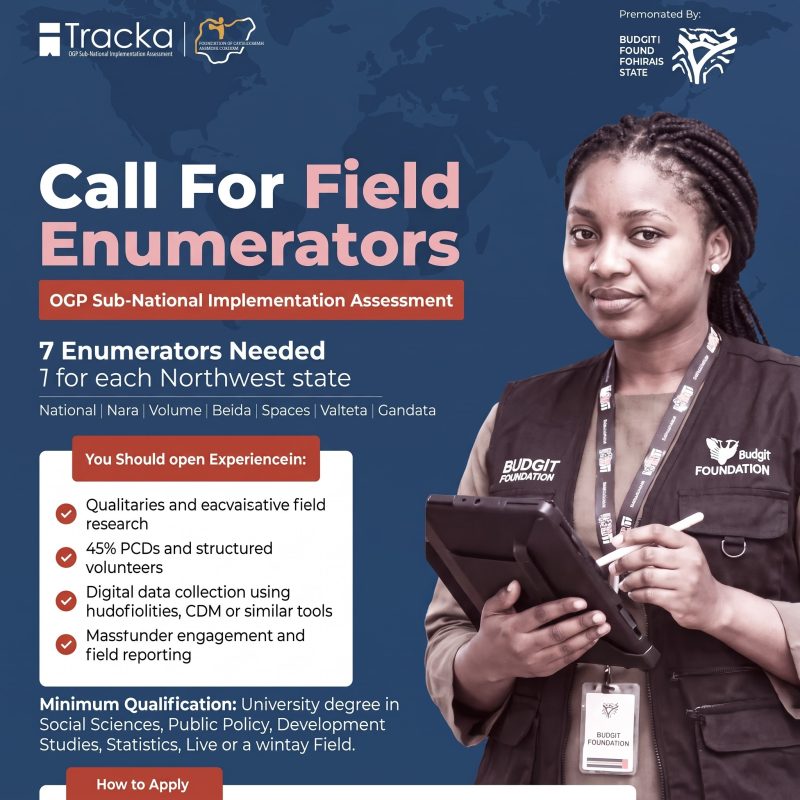
If you are passionate about transparency, accountability, and making a tangible impact in Nigeria’s governance, a unique career opportunity has just opened up. Tracka Development Foundation, a leading civic technology organization, is currently recruiting dedicated individuals for Field Enumerator Job Opportunities Across Nigeria. This recruitment drive is specifically targeted at strengthening the Open Government Partnership (OGP) Sub-National Implementation Assessment across the Northwest region.
Finding a job that perfectly aligns with a desire for social change, community development, and professional growth can be challenging. However, Tracka has consistently provided a platform for young professionals, researchers, and civil society actors to actively participate in holding the government accountable. In this comprehensive guide, we will break down everything you need to know about this enumeration job, the requirements, the application process, and how you can position yourself as the ideal candidate before the October 26, 2026 deadline.
Understanding the Tracka Development Foundation
Before diving into the specifics of the job, it is crucial to understand the organization you are applying to. Tracka is a subsidiary initiative of BudgIT, Nigeria’s foremost civic tech organization that simplifies the budget and public data for citizens. Founded with the mission to bridge the gap between the government and the grassroots, Tracka empowers ordinary Nigerians to track public projects in their communities.




For years, Tracka has deployed field officers across various states in Nigeria to monitor the execution of government projects, ensuring that funds allocated for schools, health centers, boreholes, and roads are actually utilized for their intended purposes. By applying for the Field Enumerator position, you are not just looking for a job; you are stepping into a vital role that champions anti-corruption, service delivery, and public sector transparency.
The Open Government Partnership (OGP) Assessment
The primary focus of this current recruitment is the OGP Sub-National Implementation Assessment. But what exactly is this?
The Open Government Partnership is a multilateral initiative that aims to secure concrete commitments from national and sub-national governments to promote transparency, empower citizens, fight corruption, and harness new technologies to strengthen governance. While Nigeria as a country joined the OGP years ago, the real impact is often felt at the sub-national level—meaning the state and local governments.
Tracka’s project aims to assess how well these state governments are implementing their open government commitments. Are they publishing their budgets? Are citizens involved in the procurement process? Are public records accessible? As a Field Enumerator, your job will be to go into the field, interact with stakeholders, and gather the data needed to answer these critical questions.
Job Overview and Available Locations
Tracka is looking to fill 7 specific vacancies for this project. They require one highly capable Field Enumerator for each of the seven states in the Northwest geopolitical zone of Nigeria. The available locations include:
- Kaduna State: A political and economic nerve center in Northern Nigeria. Enumerators here will navigate a mix of urban centers and remote villages, tracking projects that range from metropolitan road construction to rural agricultural interventions.
- Kano State: As the commercial powerhouse of the North, Kano boasts a massive population. Data collection here requires an enumerator who understands the bustling trade environment and can effectively engage with municipal authorities to track large-scale government commitments.
- Katsina State: Assessing OGP commitments here requires tact and a deep understanding of local socio-economic dynamics. Enumerators must be adept at mapping out communities and utilizing traditional communication channels to extract data on public spending.
- Kebbi State: Predominantly agrarian, Kebbi offers a unique landscape for assessing how government policies affect rural dwellers. An ideal enumerator will be someone skilled in breaking down complex governance language into simple, relatable concepts for farmers and local artisans.
- Jigawa State: Known for its proactive steps in digital governance, Jigawa is a fascinating state for this assessment. Enumerators will track the implementation of open contracting and evaluate how well the state’s citizens can access budget data.
- Sokoto State: Deeply rooted in tradition, Sokoto requires enumerators who respect hierarchy and know how to conduct advocacy visits to community gatekeepers before initiating focus group discussions. Building trust here is the first step to successful data collection.
- Zamfara State: Gathering data in Zamfara requires a highly resilient enumerator. The focus here will likely be on tracking basic service delivery in education and healthcare amidst complex terrains, requiring robust offline digital data collection skills.
Important Note: A strict condition for this recruitment is that applicants must reside in the state for which they are applying. Tracka is prioritizing localized knowledge. If you live in Kano, you should apply for the Kano slot. Do not apply for Zamfara if you do not reside there, as local familiarity is key to navigating the cultural and logistical nuances of the region.
Key Responsibilities of the Field Enumerator
The role of a Field Enumerator is highly dynamic. It goes beyond simply handing out questionnaires. It requires analytical thinking, excellent communication, and the ability to extract qualitative information from diverse groups of people. Here is a detailed breakdown of what your day-to-day responsibilities will entail:
1. Qualitative and Quantitative Field Research
You will be responsible for gathering mixed-methods data. Quantitative data might involve numbers—such as counting the number of completed projects or recording budget figures. Qualitative data will require you to understand the “why” and “how” behind government actions, capturing the sentiments and experiences of the citizens regarding public service delivery.
2. Conducting Key Informant Interviews (KIIs)
Key Informants are people with specialized knowledge about a specific topic. In the context of the OGP assessment, this could be a local government chairman, a community leader, a budget officer, or the head of a local NGO. You must know how to ask probing, open-ended questions, listen actively, and document their insights without bias.
3. Facilitating Focus Group Discussions (FGDs)
You will bring together small groups of community members to discuss their experiences with government initiatives. Managing an FGD requires strong facilitation skills. You must ensure that everyone has a voice, prevent dominant personalities from taking over the conversation, and guide the discussion to answer your core research questions.
4. Administering Structured Interviews and Questionnaires
For more standardized data collection, you will administer carefully designed questionnaires. This requires patience, especially when dealing with respondents who may not fully understand the terminology used in governance. You will need to translate complex concepts into local languages and easily digestible terms.
5. Digital Data Collection (KoboToolbox and ODK)
Gone are the days of carrying massive stacks of paper to the field. Tracka relies on modern civic tech. You must be proficient in using platforms like KoboToolbox or Open Data Kit (ODK). These mobile data collection apps allow you to input survey responses directly into a smartphone or tablet, even offline. Once you connect to the internet, the data syncs directly to Tracka’s central database.
6. Stakeholder Engagement and Communication
You are the face of Tracka in your state. You will need to build trust with local authorities, community members, and civil society partners. How you communicate will determine the level of cooperation you receive. Professionalism, cultural sensitivity, and respect are non-negotiable traits.
7. Accurate Field Documentation and Reporting
Collecting data is only half the job; reporting it accurately is the other half. You must demonstrate a strong attention to detail. A slight error in data entry can skew an entire state’s assessment. You will be required to write daily or weekly field reports detailing your progress, challenges encountered, and preliminary findings.
Minimum Educational Qualifications
Because the OGP Sub-National Implementation Assessment is a highly technical research project involving public policy and data analysis, Tracka has set specific educational benchmarks. Applicants must possess a university degree (BSc, BA, HND, or equivalent) in any of the following fields or a closely related discipline:
- Social Sciences: Sociology, Political Science, Economics, Geography, or Mass Communication.
- Public Policy: Degrees focused on government administration, policy analysis, and civic leadership.
- Development Studies: A perfect fit for understanding the socioeconomic impacts of government projects.
- Statistics: Crucial for the quantitative aspects of data gathering and analysis.
- Law: Highly relevant for understanding the legal frameworks behind the Open Government Partnership and state procurement laws.
While a degree is required, practical field experience often outweighs theoretical knowledge in enumeration roles. If you have a degree in a different field but possess years of demonstrable experience in digital data collection and community mobilization, you are still highly encouraged to apply.
Why Women and Local Civil Society Actors Are Prioritized
One of the standout features of this Tracka recruitment drive is the explicit encouragement for women and locally based civil society actors to apply. There is a strategic reason behind this.
In many parts of Northern Nigeria, cultural and religious norms dictate how men and women interact in public spaces. Male enumerators often face significant barriers when trying to interview women in certain communities. To ensure that the voices of women are accurately represented in the OGP assessment, female enumerators are absolutely essential. They can access spaces and facilitate focus groups with women that would otherwise be impossible, ensuring the data is inclusive and gender-representative.
Similarly, locally based civil society actors already possess the trust of their communities. They know the terrain, understand the local politics, speak the local dialects fluently (especially Hausa in the Northwest), and have existing networks with key informants. Tracka wants to leverage this localized expertise rather than bringing in outsiders who would have to learn the terrain from scratch.
Essential Skills You Must Highlight in Your Application
If you want your application to make it past the initial screening phase, you must clearly demonstrate specific skills. When the HR team at Tracka reviews your CV, they are looking for buzzwords and concrete examples of your past work. Ensure your application highlights the following:
- Attention to Detail: Mention past projects where your accuracy in data entry was critical to the project’s success.
- Digital Literacy: Explicitly list KoboToolbox, ODK, SurveyToGo, or Google Forms in the technical skills section of your CV.
- Local Language Proficiency: State your fluency in Hausa, Fulfulde, or any other local language relevant to your state of application.
- Community Mobilization: Describe a time you successfully organized a community meeting or advocacy visit with local leaders.
- Report Writing: Provide evidence of your ability to synthesize raw field data into coherent, professional reports.
How to Apply for the Tracka Field Enumerator Job
The application process for this opportunity is straightforward, but it requires absolute precision. Failure to follow the instructions carefully could result in your application being discarded without review.
Application Deadline: 26 October 2026. (Do not wait until the last minute. Apply as soon as possible to avoid internet connectivity issues on the deadline day).
Interested and qualified candidates should prepare the following two documents:
- An updated Curriculum Vitae (CV): Ensure this is tailored to the role. Remove irrelevant corporate experiences and focus heavily on your research, data collection, and NGO background.
- A Brief Cover Letter: This should not be more than one page. Explain why you are the best fit for the role, detailing your experience with KIIs, FGDs, and ODK. Make sure to express your passion for transparency and accountability.
Submission Process:
Send your CV and Cover Letter by email to: hr@mytracka.org
Crucial Instruction: In the body of your email and your cover letter, you must clearly indicate your state of residence and your preferred state of application. To make the recruiter’s job easier, it is highly recommended to use a clear email subject line. For example: “Application for Field Enumerator – Kano State”.
Only shortlisted candidates will be contacted for the next phase, which will likely involve an interview and potentially a practical test of your data collection knowledge.
Tips for Crafting a Winning NGO Cover Letter
Writing a cover letter for a civic tech organization like Tracka is fundamentally different from applying to a commercial bank or a corporate firm. Non-governmental organizations are highly mission-driven. They want to see that your personal values align directly with their organizational goals. Here is how to properly structure your cover letter for this specific role:
Paragraph 1: The Introduction. State exactly which position you are applying for and how you found out about it. Mention your current location immediately (e.g., “As a long-term resident of Kaduna State, I am writing to apply for…”).
Paragraph 2: The Technical Fit. This is where you drop the technical data collection jargon. Talk about your proficiency with KoboToolbox. Mention specific research projects you have worked on. Did you conduct 50 KIIs for a public health project? Did you facilitate FGDs for a local education initiative? Put those quantifiable numbers in there to prove your experience.
Paragraph 3: The Mission Fit. Why Tracka? Talk about your interest in governance, the Open Government Partnership, and public accountability. Let them know you understand what they do. Mentioning your passion for holding public officers accountable and tracking budgets will score you massive points with the hiring team.
Paragraph 4: The Conclusion. Reiterate your availability, your readiness to traverse your state to gather data, and thank them for their time. Include your active phone number and email address clearly at the bottom of the page.
Interview Preparation: What to Expect
If your CV and cover letter hit the mark, you will be invited for an interview. Interviews for field enumerator roles usually focus on practical field scenarios rather than theoretical academic concepts. Here are a few areas you must prepare for to ace the interview:
1. Handling Difficult Respondents
Expect a scenario-based question like: “You arrive at a local government secretariat to interview a public official, but they are hostile and refuse to answer your questions. What do you do?” The correct answer revolves around maintaining professionalism, de-escalating the situation, respecting their right to refuse, and exploring alternative legal avenues or alternative respondents to get the necessary data without causing a conflict.
2. Data Integrity and Ethics
You might be asked: “If you are running behind schedule and need 5 more questionnaires filled out by the end of the day, is it okay to fill them out yourself based on what you think the community would say?” This is a test of your integrity. The answer is an absolute NO. Data falsification is the biggest offense in research. Emphasize your strict commitment to authentic data collection, even if it means reporting a delay to your supervisor.
3. Technical Troubleshooting in Remote Areas
You will definitely be asked about your experience with ODK or KoboToolbox. Be prepared to explain how you handle situations where your mobile device crashes, the GPS location fails to capture, or you find yourself in a rural area with absolutely no internet connection. (Hint: Remind them that ODK works perfectly offline; you simply save the blank forms, collect the data offline, and sync the finalized data to the server when you return to an area with network coverage).
The Impact of Civic Technology in Nigeria
Taking on this enumeration role means becoming part of a much larger, historic movement. Civic technology is actively reshaping how democracy functions in Nigeria. Before organizations like BudgIT and Tracka emerged on the scene, government budgets were dense, physical documents locked away in offices, written in financial jargon that the average citizen could not possibly understand.
Today, because of the raw data collected by field officers and enumerators, that complex information is visualized into simple, easily digestible infographics. Citizens in remote villages in Kebbi or Jigawa now know exactly how many millions were allocated to build their local primary healthcare center. Armed with this transparent information, they can demand answers from their political representatives if the project is abandoned or poorly executed.
Your role in the OGP Sub-National Assessment is the very foundation of this advocacy. Without accurate field data, the central team in Abuja or Lagos cannot produce the reports that drive national policy changes. You are not just an enumerator filling out forms; you are a vital catalyst for transparency.
Career Growth: Where Can This Lead?
Many young professionals use field enumeration as a powerful stepping stone to highly lucrative and impactful careers in the international development sector. Working with a reputable, globally recognized civic tech organization like Tracka Development Foundation adds significant weight and credibility to your resume.
Successful enumerators who excel in their roles often transition into higher positions such as:
- Monitoring and Evaluation (M&E) Officer: Designing the logical frameworks that track the success of entire NGO programs from start to finish.
- Data Analyst: Moving away from collecting the data in the field to analyzing it in the office using software like SPSS, STATA, or Python.
- Program Manager: Overseeing the implementation of civic tech projects, managing budgets, and coordinating other enumerators across multiple states.
- Public Policy Consultant: Advising governments and international donor agencies on how to better implement OGP commitments based on actual field realities.
You should treat this short-term opportunity not just as a quick gig, but as an audition for long-term career growth in the civil society space.
Frequently Asked Questions (FAQs)
1. Can I apply if I live in Lagos but I am willing to relocate to Kano for the job?
No. Tracka specifically requires applicants to currently reside in the state they are applying for. The project relies on individuals who already deeply understand the local terrain, culture, and language. Relocating for a short-term enumeration job is not practical for the timeline and budget of this specific project.
2. Do I need to own a smartphone or tablet to apply?
Yes. Digital data collection using platforms like KoboToolbox or ODK requires an Android smartphone or a tablet. While the organization may sometimes provide specific tools, having your own reliable device and knowing how to navigate it is a standard requirement for modern enumerators.
3. Is prior experience with Tracka or BudgIT required?
No, prior work experience with Tracka specifically is not a requirement. However, previous experience in qualitative and quantitative field research, particularly within the civil society or NGO space, is highly necessary to succeed in this role.
4. What is the final deadline for the application?
The strict deadline for submitting your CV and cover letter is October 26, 2026. Late applications will not be reviewed by the HR team.
5. Is there any application fee required to process my CV?
No. Tracka Development Foundation, like all legitimate non-governmental organizations, will never ask you to pay any money to apply for a job or to process your recruitment. Beware of employment scammers and only apply through the official email address provided.
Final Thoughts on the Tracka Enumerator Recruitment
The Field Enumerator Job Opportunities Across Nigeria at Tracka Development Foundation represent a golden chance for diligent, research-oriented individuals in the Northwest region to contribute to national development. By gathering accurate, unbiased data on the implementation of Open Government commitments, you are directly aiding the fight for better public service delivery and zero corruption in public office.
Ensure your CV is thoroughly updated, write a compelling cover letter that highlights your practical field experience, and send your application to the HR team long before the deadline closes. Whether you are an experienced researcher looking for your next project or a passionate civil society actor looking to make a difference in your state, this is your moment to step into the field and let your hard work speak for the grassroots.
Get Started / Apply Now: Send your updated CV and Cover letter to hr@mytracka.org indicating your preferred state of application in the subject line.
Source: yeshub.ng