How to Pass Nigerian Job Aptitude Tests & Assessment Centres in 2026 (Free Past Questions)

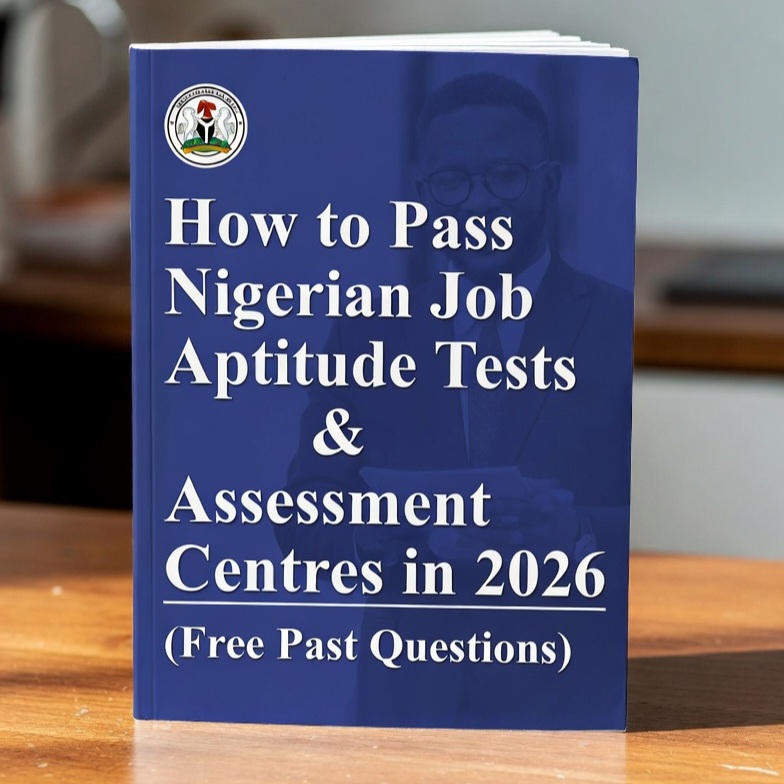
How to Pass Nigerian Job Aptitude Tests & Assessment Centres in 2026 (Free Past Questions)
Let’s face the real truth here. The Nigerian job market in 2026 is incredibly competative. Whether you are aiming for that high-paying role in a top commercial bank, a lucrative spot in the oil and gas sector, or a fast-paced position in one of Lagos’s booming tech startups, the gatekeepers are almost always the same: Job Aptitude Tests and Assessment Centres. Getting an invite is one thing, but passing it is a totally different ball game.
Many brillant graduates from OAU, UNILAG, ABU, and other top institutions often get stuck at this screening phase. Not because they aren’t smart, but simply because they don’t understand the mechanics of these tests. Passing these exams is not just about your university degree; its about speed, accuracy, and knowing exactly what the recruiters are looking for. In this comprehensive guide, I will show you exactly how to pass Nigerian job aptitude tests and assessment centres this year, and I’ll even drop some free past questions for you to practice with.
Understanding the Big Players: Who is Testing You?
Before you even start preparing, you need to know your “enemy.” In Nigeria, companies rarely set their own aptitude tests. They outsource them to specialized HR and testing agencies. If you know the agency conducting the test, you already have a massive advantage because you can predict their question format. Here are the major test providers in 2026:



- Dragnet Solutions: These guys are famous for handling recruitments for oil and gas companies (like Chevron, Shell, ExxonMobil) and FMCGs like Nestle. Dragnet tests are notoriously tough. They usually feature abstract reasoning (shapes and patterns), numerical reasoning with heavy data interpretation, and verbal reasoning. Their timer is usually your biggest enemy.
- Workforce Group: Workforce handles tests for many top Nigerian banks like First Bank, GTBank, and Access Bank. Thier questions often mimic the SHL format. You can expect standard math, English comprehension, and logical reasoning. Sometimes they throw in some current affairs about the banking sector.
- Phillips Consulting (pcl.): Known for testing public sector agencies and financial institutions. Their tests are generally balanced but require deep analytical thinking.
- SHL / Kenexa: Multinational companies operating in Nigeria usually prefer these global standard tests. They are highly structured and adaptive (the questions get harder as you answer correctly).
Whenever you get a test invite, quickly check the email address or the link provided. If it says something like “e-recruiter.ng”, that’s Dragnet. Knowing this helps you tailor your practice.
The Core Sections of Nigerian Aptitude Tests
While every agency has its unique style, the core structure of these tests revolves around three main areas. Let me break them down so you know what to expect and how to prepare without wasting your time.
1. Numerical Reasoning (Maths & Data)
Forget the complex calculus you did in engineering or economics class. Numerical reasoning in Nigerian aptitude tests is mostly basic arithmetic, percentages, ratios, fractions, and most importantly, Data Interpretation. You will be given complex graphs, pie charts, and tables, and asked to calculate profits, losses, or growth rates under immense time pressure.
Pro tip: Brush up on your mental math. You are usually allowed a calculator, but if you waste time pressing buttons for simple additions, you won’t finish. Learn to estimate answers quickly. If the options are wide apart, rounding up numbers can save you vital seconds.
2. Verbal Reasoning (English Language)
This section is designed to test your ability to understand and process written information quickly. You will typically be given a dense paragraph of text (often related to business, science, or history) followed by statements. You have to decide if the statements are True, False, or Cannot Say based only on the text provided.
Negligence warning: Most candidates fail this because they bring in outside knowledge. If the passage says “The sky is green,” and the question asks for the color of the sky, the answer is green. Leave your prior knowledge at the door!
3. Abstract / Logical Reasoning (Shapes)
This is where Dragnet usually deals with people. You will see a sequence of shapes, symbols, or patterns, and you have to guess the next one in the sequence or find the odd one out. It test your fluid intelligence and problem-solving speed. The trick here is to look for rules: rotation (clockwise or anti-clockwise), movement, color changes, or mirroring.
Surviving the Assessment Centre: The Ultimate Test
Congratulations, you passed the aptitude test! Now you’ve been invited to the Assessment Centre (AC). For many, this is the scariest part. An AC is usually a half-day or full-day event where you are grouped with other smart candidates and evaluated by a panel of assessors through various exercises.
Here are the common activities you will face in a 2026 Nigerian Assessment Centre:
- The Group Exercise: You and about 5-7 other candidates will be given a business case study to solve within 30 minutes. The assessors are not just looking for the right answer; they are watching how you behave.How to pass: Don’t be the loud, aggressive person trying to dominate everyone. Nigerians like to show themselves here, but assessors hate it. Be the facilitator. Say things like, “That’s a great point, Emeka. Fatima, what do you think about Emeka’s idea?” Keep track of time and summarize points. That shows true leadership.
- The Presentation: You might be given a topic 15 minutes prior, and asked to present it to a panel. Keep good eye contact, structure your presentation logically (Intro, Body, Conclusion), and speak clearly. Don’t let the panel’s straight faces intimidate you; they are trained to look mean to test your composure.
- The Competency-Based Interview: This is the final boss. They will ask you questions based on the STAR method (Situation, Task, Action, Result). When they ask “Tell us about a time you solved a problem,” don’t give vague answers. Describe the specific Situation, the Task you needed to do, the Action YOU took (use “I”, not “We”), and the positive Result that followed.
Free Past Questions to Practice Right Now
I promised you some free past questions to help you get a feel of what the 2026 tests look like. These are modeled after recent Workforce and Dragnet formats. Take a pen and paper and try to solve them.
Practice Question 1: Numerical Reasoning (Workforce Style)
Scenario: A retail company in Lagos sells 4,500 units of Product A in January. In February, sales of Product A drop by 15%. However, in March, sales increase by 20% from the February figures. If each unit is sold for ₦2,500, what is the total revenue generated in March?
Options:
A) ₦11,475,000
B) ₦10,800,000
C) ₦11,250,000
D) ₦9,562,500
Answer & Explanation: The correct answer is A.
Step 1: Calculate February sales. 15% drop from 4,500 = 4,500 – (0.15 * 4,500) = 4,500 – 675 = 3,825 units.
Step 2: Calculate March sales. 20% increase on February = 3,825 + (0.20 * 3,825) = 3,825 + 765 = 4,590 units.
Step 3: Calculate Revenue. 4,590 units * ₦2,500 = ₦11,475,000.
Practice Question 2: Verbal Reasoning (Dragnet Style)
Passage: “The Central Bank of Nigeria (CBN) introduced new monetary policies in Q1 2026 to curb the rising inflation which had affected the purchasing power of the middle class. While commercial banks have complied with the new lending rates, small business owners argue that the stringent conditions attached to new loans are stifling innovation and expansion in the informal sector.”
Statement: Commercial banks are responsible for stifling innovation in the informal sector.
Options:
A) True
B) False
C) Cannot Say
Answer & Explanation: The correct answer is C (Cannot Say). The passage states that small business owners argue that the stringent conditions attached to new loans are stifling innovation. It does not explicitly state as a fact that the banks themselves are responsible, only that this is the argument of the business owners based on the CBN’s policies. You cannot assume it is definitively true based only on the text.
Practice Question 3: Logical/Abstract Reasoning
Question: Look at a sequence where a black dot moves across a 3×3 grid. In frame 1, it is in the top-left. In frame 2, it is in the top-right. In frame 3, it is in the bottom-right. Where will it be in frame 4?
Answer: Bottom-left. The pattern is clearly moving clockwise around the corners of the grid.
Pro Tips to Stand Out and Secure the Job
You can practice a million questions, but if your strategy on the actual exam day is poor, you will still fail. Here are some insider secrets that have helped countless candidates secure their dream jobs in Nigeria this year.
- Network connectivity is your lifeblood: Since COVID-19, 80% of first-stage aptitude tests are written from home. Please, I beg you, do not rely on a single network provider. Have MTN, Airtel, and Glo ready. A network fluctuation that logs you out for 3 minutes can cost you the job.
- Don’t get stuck: Most Nigerian aptitude tests have negative marking (especially Dragnet). But even if they don’t, time is of the essence. If you spend 3 minutes on a tough math question, you just missed out on answering 4 easy English questions. Guess, flag it, and move on!
- Use external mouse for laptops: Navigating through complex graphs and clicking small radio buttons using a laptop trackpad will slow you down. A cheap N3,000 external USB mouse will increase your speed by at least 15%.
- Sleep: Alot of candidates stay up till 4 AM cramming past questions and then write the test at 9 AM with a foggy brain. Aptitude tests require sharp cognitive function, not just memorized formulas. Get 8 hours of sleep.
Your Next Steps to Career Success in 2026
Passing a Nigerian aptitude test is not magic; it is simply a product of consistent, targeted practice. Start practicing weeks before you even apply for the job. Don’t wait until you receive a “You have been invited for a test” email on a Tuesday for a test scheduled on Thursday. You won’t have enough time to prepare.
If you are serious about taking your career to the next level and want to practice with a comprehensive database of real, up-to-date Nigerian past questions, you should definitely register on an official job prep platform.
To get started with official practice materials, mock exams, and the latest job listings, sign up here: Get Started on Jobberman Nigeria.
Keep pushing, keep practicing, and don’t let rejection emails discourage you. Every test you take makes you sharper for the next one. The hustle is real, but your dream job is definetly within reach this 2026. Good luck!