NAQS Physical Screening Protocols 2026: Guidelines, Required Documents and Important Instructions

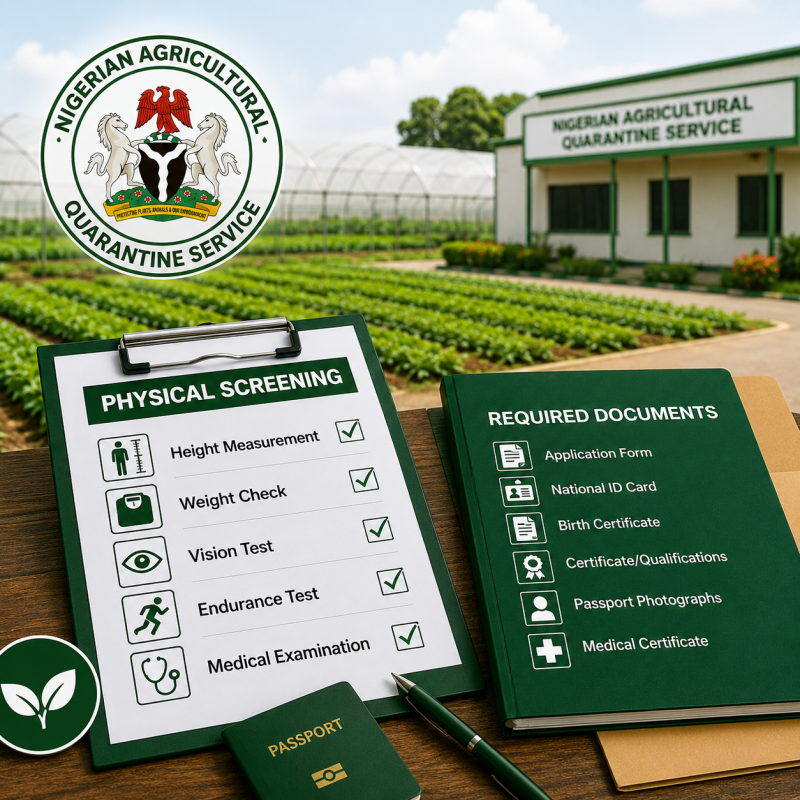
NAQS Physical Screening Protocols 2026, Guidelines, Required Documents and Important Instructions
The Nigeria Agricultural Quarantine Service (NAQS), a specialized regulatory agency operating under the Federal Ministry of Agriculture and Food Security, plays a critical national role in safeguarding Nigeria’s agricultural economy. Tasked with preventing the introduction, establishment, and spread of foreign pests, plant diseases, animal pathogens, and invasive aquatic species, NAQS operates across the nation’s international airports, seaports, land borders, and post-entry quarantine stations. Joining this agency requires undergoing a rigorous recruitment process designed to select individuals who are mentally, academically, and physically equipped for regulatory enforcement and technical duties.
For candidates who successfully submitted their applications during the online recruitment exercise, advancing to the physical screening stage represents one of the most critical phases. The physical screening exercise is not a mere formality; it is an intensive verification process where candidates’ credentials, physical parameters, medical fitness, and identity are thoroughly scrutinized by a joint panel of officers and regulatory observers.
This detailed guide provides an exhaustive breakdown of the official NAQS Physical Screening Protocols for 2026, outlining the exact guidelines, required documentation, physical standards, cadre requirements, and step-by-step instructions needed to pass the exercise without risk of disqualification.


Overview of the NAQS 2026 Recruitment & Screening Cadres
The NAQS recruitment framework categorizes candidates into three distinct operational cadres, each tailored to specific educational attainments and career entry points. The physical screening process applies strict standards customized to these cadres:
- Superintendent Cadre: Positioned for leadership, scientific evaluation, legal compliance, and field management. Key entry grades include Chief Superintendent of Quarantine (requiring a Doctor of Veterinary Medicine – DVM degree), Deputy Superintendent of Quarantine (requiring an LL.B or relevant Master’s Degree), and Assistant Superintendent of Quarantine II (requiring a Bachelor’s Degree or HND from a recognized institution alongside a valid NYSC discharge or exemption certificate).
- Inspectorate Cadre: Designed for technical, supervisory, and laboratory assistance roles. Positioned primarily as Inspector of Quarantine (I–III), this cadre requires an Ordinary National Diploma (OND) or National Certificate in Education (NCE) from a recognized tertiary institution.
- Assistant Cadre: Focused on general support, border surveillance assist, and basic quarantine operations. Entry as Quarantine Assistant (I–III) mandates Senior Secondary School Certificate Examination (SSCE), NECO, or GCE with a minimum of 4 to 5 credits including English Language and Mathematics obtained in not more than two sittings.
Understanding your specific entry cadre is vital, as the document requirements and physical expectations are calibrated according to the position applied for.
Physical, Physical Fitness, and Medical Screening Standards
Because NAQS officers often perform duties in demanding environments—such as cargo ships, border posts, field farms, and international freight terminals—candidates must satisfy specific height, physical measurement, and health requirements. Failing to meet these physical thresholds will result in immediate disqualification at the venue, regardless of academic qualifications.
1. Minimum Height and Chest Expansion Requirements
During the physical screening exercise, trained officers measure candidates without footwear. The established physical benchmarks are strictly enforced:
- Male Applicants: Must possess a minimum height of 1.65 metres (approx. 5 feet 5 inches). Additionally, male candidates must meet a minimum expanded chest measurement of 0.87 metres.
- Female Applicants: Must possess a minimum height of 1.55 metres (approx. 5 feet 1 inch).
2. Physical Body Inspection and Disqualifying Conditions
Candidates undergo a visual and physical body assessment conducted by assigned medical personnel. To maintain high operational standards and candidate safety, the following conditions serve as explicit grounds for non-clearance:
- Limb Deformities & Physical Impairments: Severe bow legs, knock knees, flat feet, or spinal curvature that inhibits full mobility and endurance.
- Sensory Impairments: Total or severe visual impairment, color blindness (which impairs agricultural pest identification), or uncorrected hearing loss.
- Speech Defects: Severe stammering or speech impediments that prevent effective communication during official regulatory inspections.
- Body Art & Insignia: Visible body tattoos, cult-related scarification, or unexplained surgical scars that suggest past involvement in illicit activities.
- Pregnancy & Advanced Medical Conditions: Due to the rigorous physical drills, endurance tests, and prolonged standing involved in the screening and subsequent basic training, pregnant women are officially advised against participating in physical drills. Candidates with uncontrolled hypertension, epilepsy, or severe asthma are similarly flagged during medical evaluation.
Comprehensive Requirements Table by Cadre
To assist applicants in preparing the correct documentation and physical baseline, the table below outlines the core requirements across all three NAQS cadres:
| Cadre / Position | Minimum Educational Qualification | Statutory Certificates Needed | Physical Benchmarks |
|---|---|---|---|
| Superintendent Cadre (Assistant, Deputy & Chief) |
B.Sc, HND, LL.B, or DVM degree from a recognized university | NYSC Discharge / Exemption Certificate, O’Level, State of Origin, NIN | Male: 1.65m height, 0.87m chest. Female: 1.55m height |
| Inspectorate Cadre (Inspector of Quarantine I–III) |
OND, NCE, or equivalent ND diploma | O’Level results, State of Origin Certificate, NIN, Medical Fitness | Male: 1.65m height, 0.87m chest. Female: 1.55m height |
| Assistant Cadre (Quarantine Assistant I–III) |
SSCE / NECO / GCE with 4–5 credits (Eng & Math incl.) in max 2 sittings | FSLC, Birth Certificate / Age Declaration, State of Origin, NIN | Male: 1.65m height, 0.87m chest. Female: 1.55m height |
Mandatory Required Documents for NAQS Physical Screening 2026
Document verification is a zero-tolerance stage during the physical screening exercise. Presenting incomplete, damaged, or unverified documents will result in candidate rejection. All candidates shortlisted for the screening physicals must arrive at their designated venue with both Original Credentials and at least three (3) sets of clear photocopies, neatly arranged in separate file jackets.
1. Primary Identification and Legal Documents
- National Identification Number (NIN) Slip: A verified, clear copy of your official NIN slip issued by NIMC. The name, date of birth, and gender on your NIN slip must match your application profile exactly.
- Certificate of State of Origin / Local Government Identification: An official document signed and stamped by your Local Government Chairman, Secretary, or Liaison Officer confirming your state and LGA of origin. This is used for federal character compliance.
- Birth Certificate or Statutory Declaration of Age: An official birth certificate issued by the National Population Commission (NPC). Candidates born before NPC establishment may present a valid Court Declaration of Age sworn at a High Court or Magistrate Court.
2. Educational and Academic Qualifications
- Primary School Leaving Certificate (FSLC): First School Leaving Certificate or official Testimonial from your primary institution.
- Secondary School Certificate (SSCE/NECO/GCE/NABTEB): Original statement of results or original certificate showing required credit passes including English Language and Mathematics. If you are using two sittings, bring original copies of both statement of results. WAEC/NECO scratch cards must be affixed or provided for online verification.
- Tertiary Diplomas & Degrees (For Superintendent & Inspectorate Cadres): Original OND, NCE, HND, B.Sc, LL.B, or DVM certificates. Statement of results are accepted only if the graduation date falls within acceptable institutional windows.
3. Statutory Discharge and Professional Records
- NYSC Discharge or Exemption Certificate: Mandatory for all candidates applying for degree-level or HND-level positions in the Superintendent Cadre. Neither a call-up letter nor an active service undertaking will be accepted in place of a discharge/exemption certificate.
- Professional Certificates and Licenses: For specialist roles (e.g., Veterinary Medical Council registration for DVM holders, Nigerian Bar Association call-to-bar certificate for legal cadres), original practicing licenses or registration certificates must be presented.
4. Administrative and Medical Requirements
- Certificate of Medical Fitness: An authentic, original medical fitness report obtained from a recognized Government Hospital (Federal Medical Centre, General Hospital, or University Teaching Hospital). Reports from private clinics or unverified laboratories are strictly invalid. The certificate must explicitly confirm blood pressure, chest X-ray status, eye vision, and physical fitness for endurance exercises.
- Printed Application Acknowledgement Slip: The official registration confirmation slip generated from the NAQS portal upon initial application submission.
- Screening Invitation Letter / Email Printout: The official invitation sent to your registered email address or printed directly from your online candidate dashboard.
- Recent Passport Photographs: At least eight (8) recent, unedited passport-sized photographs taken against a plain white background. Write your full name, application reference number, and state on the reverse side of each photo.
Step-by-Step Breakdown of Physical Screening Day Protocols
To avoid confusion and maintain orderly operations, the NAQS screening committee enforces a structured workflow at every screening center across the country. Understanding this procedure helps candidates prepare mentally and arrive equipped for each stage.
Stage 1: Arrival, Security Search, and Crowd Management
Screening centers open as early as 6:00 AM. Candidates must arrive punctually at their designated time slot. Security officers at the perimeter gate conduct initial checks to ensure only candidates with printed screening invitations gain entry. Prohibited items—such as contraband, electronic gadgets, backpacks, metallic weapons, or writing materials inside unauthorized bags—are confiscated at the security gate.
Stage 2: Queue Formation and Accreditation
Once inside the holding area, candidates are grouped into queues according to their cadres (Superintendent, Inspectorate, Assistant) and state of origin. Screening officials verify names against the master shortlisted candidate list printed directly from the NAQS database. You will be issued a candidate tracking tag or stamp upon initial accreditation.
Stage 3: Height, Chest, and Physical Measurement Verification
Candidates proceed to the physical assessment zone. Officers use calibrated stadiometers to record height, while tape measures determine male chest expansion. Physical checks for posture, limb deformities, and visible tattoos are conducted in private booths by trained health personnel. Candidates who fail to meet the height or physical criteria are immediately directed to an exit desk where their slip is marked accordingly.
Stage 4: Document Audit and Verification Desk
Candidates who pass the physical checks proceed to the document verification desk. Panel officers carefully examine original credentials alongside photocopies:
- Cross-checking certificate names with NIN details.
- Verifying graduation dates against NYSC mobilization rules.
- Conducting online scratch-card verification for O’Level results.
- Checking Local Government identifications against state quota distributions.
Stage 5: Biometric Verification and Data Capture
Following document clearance, candidates proceed to digital workstations where fingerprint scans and live facial captures are conducted. This step ensures that candidate details match the initial online portal submission and prevents impersonation.
Stage 6: Aptitude Test / CBT & Interview Screening
Depending on the specific recruitment cycle schedule, candidates who pass physical document verification either proceed directly to a Computer-Based Test (CBT) hall or participate in an oral interview panel assessment. CBT questions typically focus on general knowledge, current affairs, basic English language, numerical reasoning, and fundamental agricultural quarantine policies.
Stage 7: Final Endorsement and Stamped Slip Clearance
NAQS Physical Screening Protocols 2026: Upon successfully passing all verification stages, your primary screening acknowledgment slip will be officially stamped and signed by the screening center lead officer. Retain this stamped copy safely, as it serves as your official proof of physical screening completion when final training call-up lists are published.
Critical Mistakes That Lead to Automatic Disqualification
Every recruitment year, hundreds of qualified candidates are turned away from screening centers due to avoidable errors. Pay close attention to the following common pitfalls:
- Name Mismatches Across Documents: Having “John Chukwuma Okafor” on your NIN, “John C. Okafor” on your degree certificate, and “Chukwuma Okafor” on your NYSC certificate without a legally recognized Affidavit of Correction or Newspaper Change of Name publication will cause instant document rejection. Ensure name order and spelling match precisely.
- Forged or Fake Documents: Presenting forged O’Level statements, altered birth certificates, or fake medical reports from non-governmental hospitals leads to immediate disqualification and potential handover to law enforcement authorities.
- Age Falsification: Attempting to alter birth declaration dates to fit cadre age limits. Screening officers audit certificate issuance dates against claimed age.
- Proxy Appearance and Impersonation: Sending someone else to represent you at the physical screening venue is caught during biometric validation, resulting in a permanent blacklist from federal civil service recruitment.
- Missing Key Qualifications: Applying for a Superintendent position without an NYSC Discharge or Exemption Certificate, or applying for Quarantine Assistant without required mathematics or English credits.
Dress Code and Physical Conduct at the Screening Venue
Your appearance and behavioral conduct during the physical screening reflect your discipline and readiness for paramilitary work. Candidates are expected to adhere strictly to the following dress guidelines:
For Male Candidates:
- Upper Wear: Plain white round-neck T-shirt (free of bold logos, graphics, or political prints).
- Lower Wear: Plain white athletic shorts or white track pants.
- Footwear: Plain white canvas shoes or athletic running shoes paired with white socks.
- Grooming: Neat, low haircut and clean-shaven face. Excessive jewelry, earrings, or unkempt hair are prohibited.
For Female Candidates:
- Upper Wear: Plain white round-neck T-shirt.
- Lower Wear: Plain white or navy blue athletic track pants/shorts.
- Footwear: Comfortable athletic white canvas or running shoes with socks.
- Grooming: Tidy hair tied neatly back away from the face. Minimal makeup, no long artificial nails, and no hanging jewelry that poses safety risks during physical exercises.
Essential Items to Pack for Screening Day
Because physical screening involves long hours of waiting, physical evaluation, and administrative processing, arriving prepared ensures comfort and focus. Bring the following items in a small, organized clear plastic folder:
- Your clear office file jacket containing all original credentials and 3 sets of photocopies.
- At least two (2) blue ballpoint pens and a glue stick for fixing passport photos on verification forms.
- WAEC/NECO online result verification scratch cards (where applicable).
- A pocket-sized hand sanitizer and basic personal hygiene items.
- Sufficient light personal refreshments (water bottle, light snacks) as food vendors may not be accessible within screening zones.
- Valid original photo ID card (Voter’s Card, Driver’s License, International Passport, or NIN Card).
Official Portal Verification and Shortlist Status
Candidates must avoid third-party blogs or unauthorized individuals claiming to offer screening passes or recruitment shortcuts in exchange for payment. NAQS recruitment exercises are completely free of charge. All official updates regarding screening center allocations, batching lists, time slots, and requirements are published directly on the official agency recruitment portal.
To verify your shortlisting status, print your official invitation slip, or access your candidate dashboard, visit the official link below:
NAQS Official Recruitment Portal – Get Started & Check Shortlist Status
Frequently Asked Questions (FAQs)
1. Is the NAQS Physical Screening free of charge?
Yes. The Nigeria Agricultural Quarantine Service recruitment exercise is 100% free. No candidate is required to pay money to any officer, agent, or portal for screening clearance. Anyone demanding payment is attempting a scam.
2. Can I present a medical fitness certificate from a private hospital?
No. Screening rules strictly mandate that medical fitness certificates must originate from an authentic Government Hospital (General Hospital, Federal Medical Centre, or Teaching Hospital). Private clinic reports will be rejected during document auditing.
3. What happens if I miss my scheduled screening date?
Screening is conducted strictly according to scheduled batches and time slots. Candidates who fail to appear on their assigned date without prior formal authorization risk forfeiting their participation in the recruitment exercise.
4. Will there be an endurance run or physical exercise?
Yes. Depending on venue facilities and cadre requirements, candidates may undergo light physical exercises, drill routines, posture checks, and height/chest evaluations to assess physical endurance.
5. Can I present an Affidavit for a missing O’Level certificate?
No. An affidavit cannot replace a missing O’Level result certificate or official statement of result. However, an affidavit is acceptable for clarifying minor name order discrepancies when accompanied by an official newspaper publication.
6. How long does the physical screening process take?
The entire verification workflow—from morning queue accreditation to document verification and biometric capture—usually lasts several hours. Candidates are strongly advised to arrive early and prepare for a full-day exercise.
Conclusion
Attending the 2026 NAQS physical screening exercise is a pivotal opportunity to secure a career within one of Nigeria’s premier agricultural regulatory bodies. Success during this phase depends heavily on meticulous preparation: ensuring your original credentials match your application profile, obtaining a genuine medical fitness report, meeting physical fitness benchmarks, and maintaining professional conduct throughout the venue. Organise your documents early, double-check your designated venue details on the official portal, and arrive prepared to demonstrate your fitness for service.